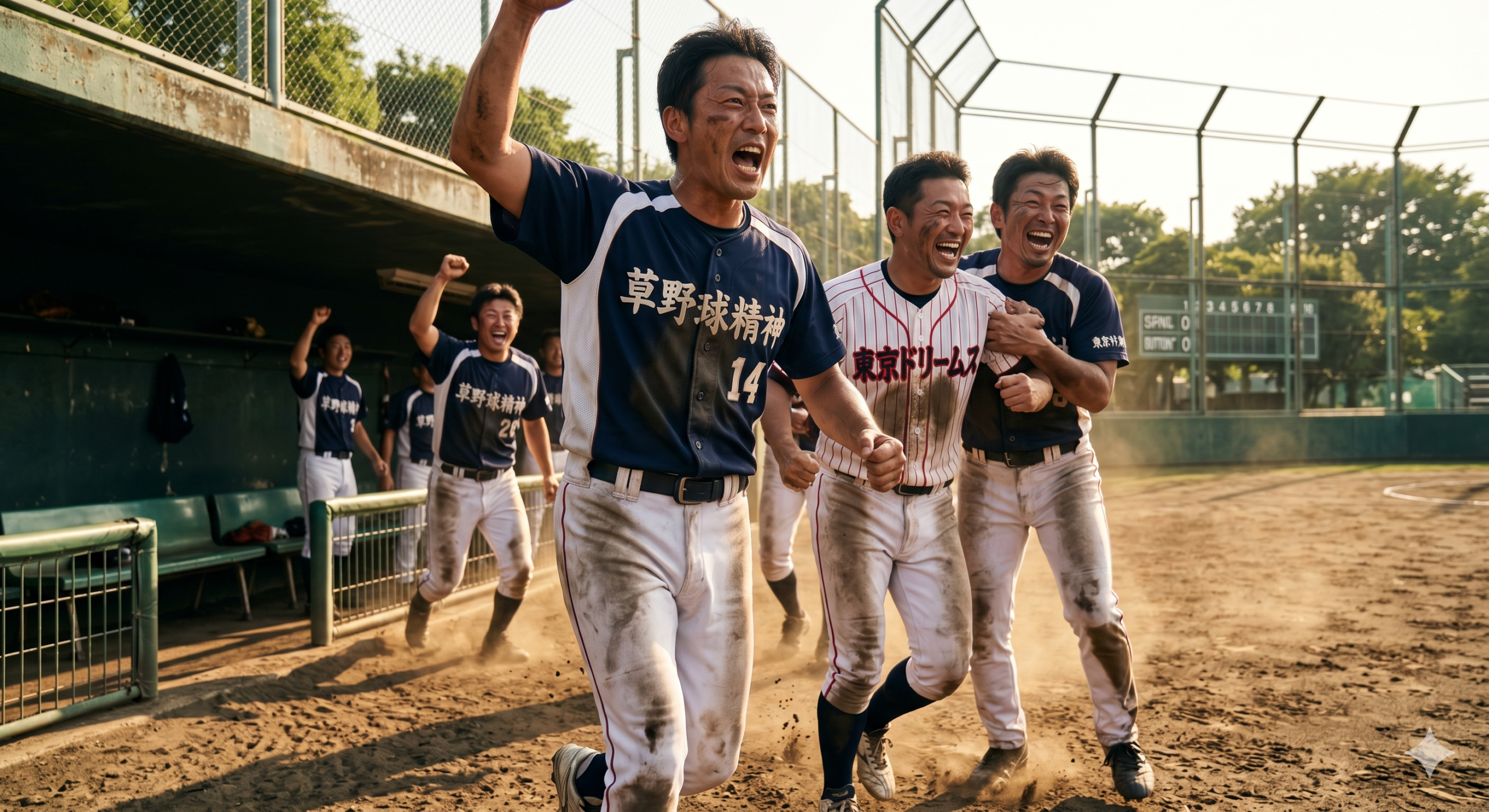

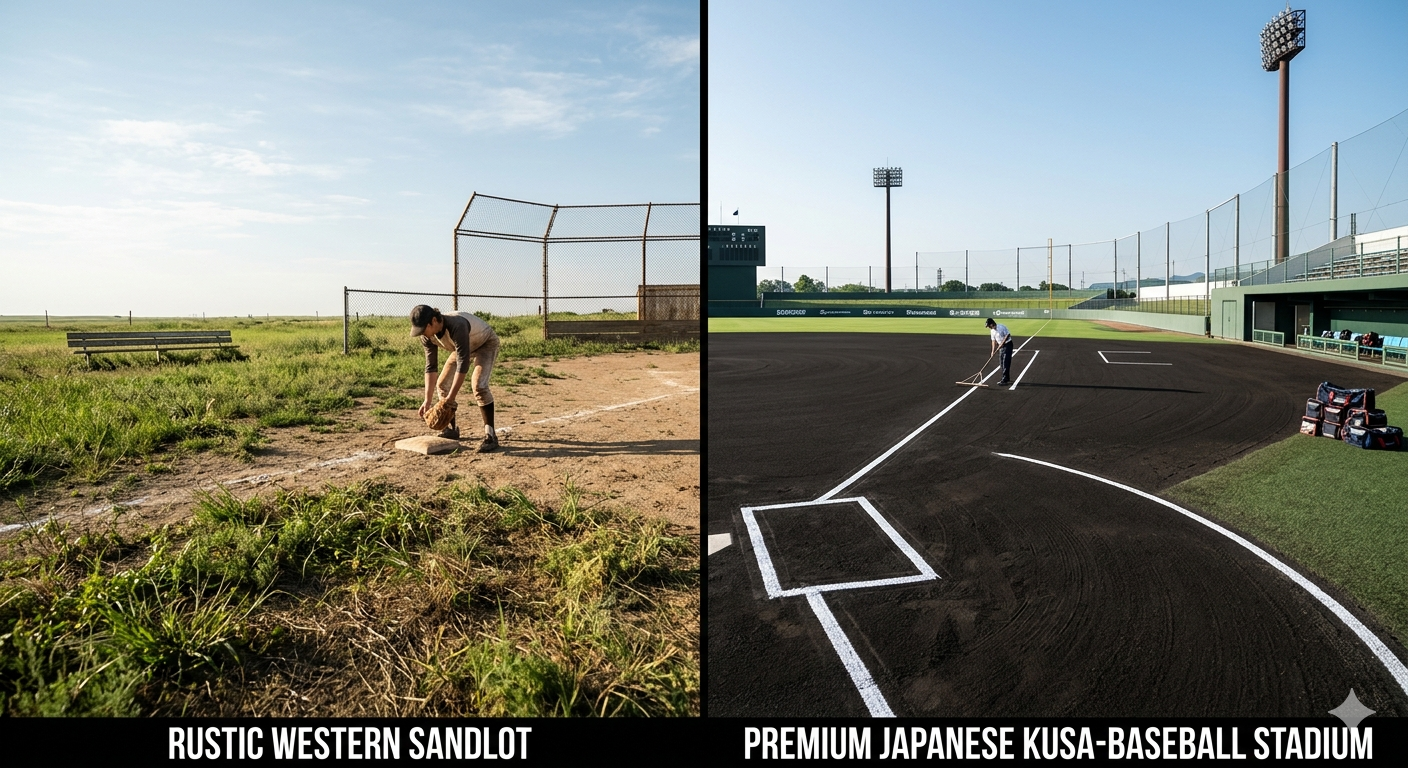
For many baseball fans in the West, amateur ball means casual weekend sandlot games or laid-back recreational leagues[cite: 1]. You grab a beaten-up glove, head to a wide-open grassy park, and just throw the ball around[cite: 1]. But in Japan, our weekend obsession known as Kusa-Baseball operates in a completely different dimension[cite: 1].
1. Pristine Public Diamonds vs. Wide-Open Spaces
In the West, sandlot games often happen on any available patch of grass or a multi-purpose park field[cite: 1]. Japanese Kusa-Baseball, however, is almost exclusively played on dedicated, beautifully maintained public stadiums called Kyujo[cite: 1]. These fields feature perfectly caked dark infield dirt, caging, and professional foul lines[cite: 1].
2. Professional-Grade Gear Obsession
While a casual sandlot player might use an old glove from high school, Kusa-Baseball players treat their gear like professional athletes[cite: 1]. It is entirely normal to see an amateur carrying a customized leather glove with gold name embroidery[cite: 1]. Teams also invest heavily in high-tech urethane bats and identical, custom-designed jerseys[cite: 1].
“We do not view Kusa-Baseball as a casual weekend distraction; we approach the diamond with the structural discipline and respect of a professional league.”
3. The Governing Body and Rigid Rules
Western rec leagues are usually self-governed or managed by local community centers with highly flexible rules[cite: 1]. In sharp contrast, a massive portion of Japanese amateur teams register under the JSBB (Japan Rubber Baseball Association)[cite: 1]. This association enforces strict official rules, tracking uniform compliance, strict equipment stamps, and official umpire deployments[cite: 1].
4. The Organized ‘Suketto’ Call-Up System
If an American sandlot team is short a player, they might just ask a bystander or play with an empty outfielder spot[cite: 1]. In Japan, we utilize a highly organized network to find a temporary player, known as a Suketto (helper)[cite: 1]. These guest players wear their own official team uniforms but play with absolute intensity to respect the host team’s competitive spirit[cite: 1].
5. Deep Etiquette and the ‘Tombo-gake’ Ritual
The final, most profound gap lies in the post-game manners[cite: 1]. When a Western sandlot game ends, players pack their bags, grab a beer, and head straight home[cite: 1]. In Japan, both teams line up at home plate, bow deeply, and then execute Tombo-gake[cite: 1]. Every adult grabs a T-shaped wooden rake to smooth the infield dirt until it is perfectly flat for the next group[cite: 1].
Bridging the Two Baseball Worlds
Understanding these five major gaps reveals that Kusa-Baseball is much more than a mere sport; it is a direct reflection of Japanese culture[cite: 1]. The deep structure, attention to detail, and community respect elevate the game into a beautiful art form[cite: 1]. Stay tuned as we dive even deeper into this incredible, mud-caked universe[cite: 1].